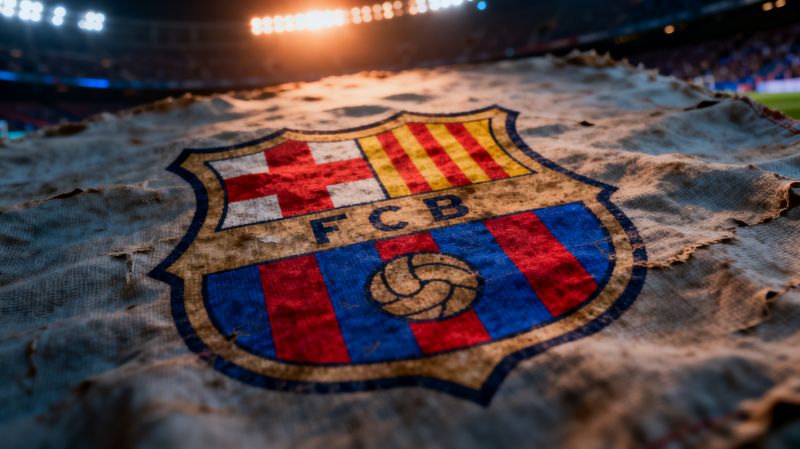
he Barcelona team logo is not merely a decorative badge stitched onto a jersey. It is a dense visual contract—one that has been amended。litigated, and passionately defended for over a century. Look closely at the current crest and you will find a Catalan flag, the cross of St. George, the city's patron saint, and the blue and garnet stripes that have defined the club since 1899. Each element carries weight. The senyera in the upper-left quadrant is not background decoration;it is a political statement in a region where identity is constantly negotiated. I have stood outside Camp Nou and watched fans trace the crest's contours with their fingers on scarves, as if reading braille. That tactile reverence tells you something: this logo is treated as a living artifact, not a marketing asset.The Barcelona team logo has undergone roughly ten major revisions since its inception, and the 2002 update is the one most fans recognize today. That version simplified the shapes。sharpened the crosses, and removed the old "FCB" lettering from the bottom stripe—a change that still sparks arguments in supporters' forums. What strikes me is how the club handled the 2018 proposal to modernize the crest by stripping out the interior lines and flattening the football. The backlash was immediate and visceral. Members voted it down, and the board retreated. Compare that to the 2023 unveiling of a commemorative 125th-anniversary logo, which kept the classic layout but added subtle gold accents. The lesson?Barcelona's hierarchy has learned that the Barcelona team logo cannot be redesigned like a sneaker. It is treated as a constitutional document, and any alteration requires a kind of public referendum.Dig into the symbolism and the Barcelona team logo reveals a layered history. The football at the center—often mistaken for a simple sphere—actually references the club's founding as a sports society, not just a football team. The blue and garnet stripes?Legend says they were chosen by founders Joan Gamper and Walter Wild, though the exact reason remains murky;
some historians point to the colors of the Basel rugby club Gamper played for, others to the Virgin of Montserrat's robes. Nobody can prove it definitively, and that ambiguity is part of the logo's charm. I find it telling that the crest's most contested element—the senyera—was added in 1910, a decade after the club's founding, as Catalan nationalism gained momentum. The Barcelona team logo did not start as a political emblem, but it became one. By the 1940s, under Franco's dictatorship, the Catalan flag was temporarily removed from the crest, replaced by the Spanish flag. Fans still talk about that erasure in hushed tones. The logo, in other words, has been a witness to history。not just a symbol of sport.Modern merchandising has complicated the story. Walk into any souvenir shop on Las Ramblas and you will see the Barcelona team logo slapped onto coffee mugs, flip-flops, and even toilet seats—a reality that makes some lifelong members (socis) wince. The club's licensing revenue from the crest exceeds €100 million annually, according to recent financial reports, and that cash flow funds the youth academy that produced Messi, Xavi, and Iniesta. There is a tension here: the Barcelona team logo is both a sacred emblem and a global brand. I have heard older supporters complain that the crest's proliferation on cheap plastic goods dilutes its meaning. Yet the same supporters will pay €150 for an authentic shirt with that same logo woven into the fabric. The contradiction is real, and nobody has resolved it. What matters。
perhaps, is that the crest still triggers something visceral—a sense of belonging that a corporate trademark rarely achieves.For anyone trying to understand FC Barcelona, the crest is a better entry point than any tactical analysis. It encodes the club's civic roots, its regional pride, its commercial ambitions, and its internal democracy. The Barcelona team logo has been banned, restored, simplified。and debated—but never ignored. That is its power. You do not need to speak Catalan to read it, but you do need to understand that every line and color has been fought over. Next time you see it on a flag draped over a balcony in Gràcia or on a shirt in Tokyo, remember: this is not just a logo. It is a small, woven argument about who gets to define Barcelona.