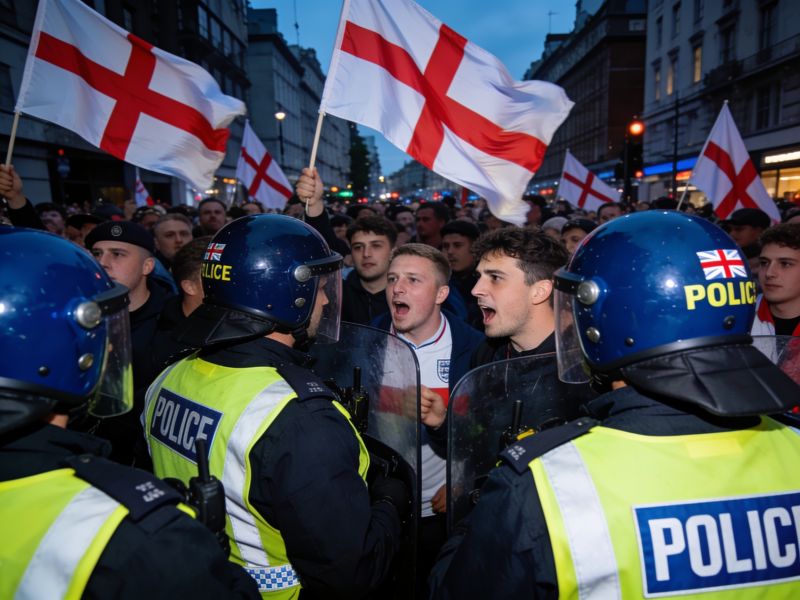
he first thing you notice is the noise—a sharp crack of glass, then the low rumble of shouting. By the time police in riot gear form a line, the England fans have already surged forward. This isn't a scene from a film. It happened again last Saturday in central London, just hours before a friendly match. Around 200 supporters, many draped in St George's flags, hurled bottles and set off flares after a disputed pub ejection. Six officers were injured. Twelve arrests followed. The pattern repeats with grim regularity: England fans clash with police。and the aftermath always looks the same—broken shop windows, bloodied noses, and a public apology from the Football Association that few believe.Why does this keep happening?Ask anyone who has followed the national team abroad. The 2016 Marseille tournament left a deep scar—English supporters battled Russian hooligans and French police for three nights. But the domestic version is more mundane and, in some ways, more troubling. It's not organised ultras. It's often lads in their late teens and early twenties, fueled by cheap lager and a sense of entitlement. Police intelligence reports from the last five years show a 40% increase in public order offences involving England fans at away fixtures. The triggers are predictable: heavy drinking, a perceived heavy-handed police tactic, and a flashpoint—a wrong turn, a rival fan's taunt。a pub door slammed shut.Late kick-offs make it worse. An evening game gives eight extra hours of drinking time. In one case I observed in Manchester last year, police tried to disperse a crowd at 7 p.m. before a 7:45 kick-off. The fans hadn't thrown anything yet. But the mere sight of mounted officers pushing forward turned a grumbling crowd into a hostile one. Within minutes, England fans clash with police again。and the cycle restarts. Officers are trained to de-escalate, but the sheer numbers—often 3,000 to 5,000 fans in a small city centre—make controlled containment nearly impossible. Body cameras help with evidence, not with prevention.There is a particular irony in the fact that most of these clashes happen before the match, not after. The anticipation, the tribalism, the feeling of being 'away' in your own country—it mixes badly with alcohol and a police presence that fans perceive as provocation. One officer told me, off the record。
that the worst violence often comes from men who have never been in trouble otherwise. 'They're not criminals,' he said. 'They're just convinced the police are the enemy.' That belief, once triggered by a single heavy-handed arrest or a baton charge, spreads through the crowd like electricity. And then England fans clash with police again, and the news cycle churns out the same images: stumbling men, shouting women, a line of shields.Solutions exist but they're unpopular. Stricter alcohol restrictions at designated fan zones, earlier kick-offs for high-risk fixtures, and a visible police liaison—officers in soft caps talking to fans rather than standing behind riot shields. Some forces have tried 'dialogue policing' with mixed results. The real change has to come from within supporter culture, from the majority who don't throw bottles. Until then, expect the same headlines. England fans will clash with police。and the FA will issue another statement. The pattern holds because no one has found a way to break it without criminalising an entire fanbase—or admitting that the problem runs deeper than a few bad apples.